
As a business owner, I used to think “culture” was something that just happened—a byproduct of hiring nice people and having a good product. But after reading Daniel Coyle’s The Culture Code with my book club, I realized that high-performing culture isn’t an accident. It’s a set of intentional behaviors.
We decided to move away from vague mission statements and toward 5 Culture Rules that define how we show up for our team and, most importantly, for our clients.
If you’re looking to sharpen your own team’s focus, here is the framework we use to keep our “signal” strong.
1. Happy to Help
In a high-pressure environment, it’s easy for “helpful” to become “transactional.” We’ve codified Happy to Help to ensure our default setting is one of radical service. This isn’t just about being polite; it’s about creating psychological safety. When a client or a teammate reaches out, they shouldn’t feel like an interruption. They are the reason we’re here.
2. Own the Outcome
There is a massive difference between doing a task and owning an outcome. We encourage our team to look past the checklist. A project isn’t “done” when the file is sent; it’s done when the client is happy and the goal is met. By seeing it through to the finish line, we eliminate the “not my job” mentality that kills so many small businesses.
3. Learn and Grow Together
The best cultures are “learning machines.” We know we don’t have all the answers, but we promise to find them together. By prioritizing continuous improvement and collaboration, we turn individual mistakes into institutional knowledge. We win as a team, and we level up as a team.
4. Grow Our Clients
We believe our success is a lagging indicator of our clients’ success. This rule pushes us to be proactive rather than reactive. We don’t just wait for instructions; we look for ways to help our clients improve their own businesses. When we focus on their growth, our growth takes care of itself.
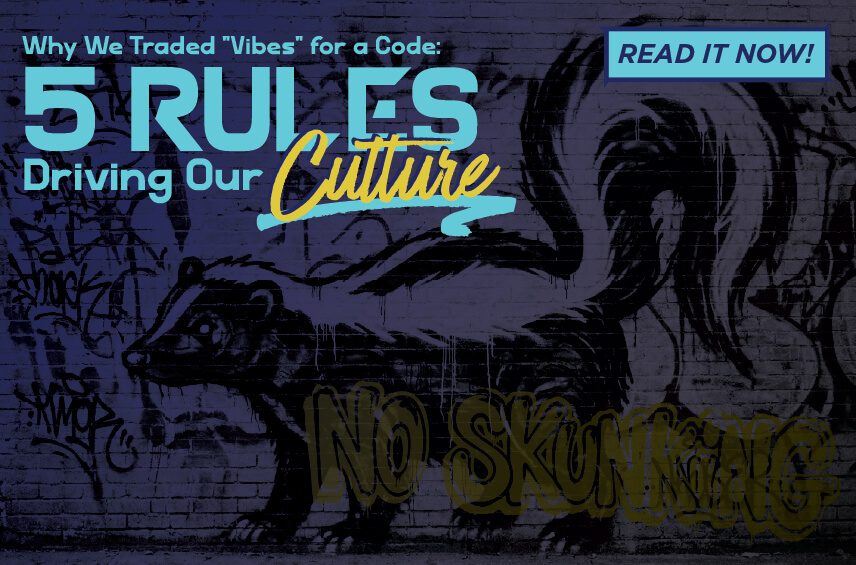
5. No Skunking
This is perhaps our favorite (and most unique) rule. “Skunking” is the act of letting a bad attitude or “stinky” energy permeate the room. In The Culture Code, Coyle discusses how one “bad apple” can tank a team’s productivity by 30-40%. We have a zero-tolerance policy for negativity that doesn’t offer a solution. We keep it positive, keep it constructive, and keep the “skunks” out of the office.
The Bottom Line: Culture isn’t about what you say in an orientation video; it’s about the small, repeated signals you send every day. These five rules are our signals.
What are you building?
If you’re a business owner, I’d love to hear from you. Have you read The Culture Code? What are the non-negotiable rules that keep your team moving in the same direction?